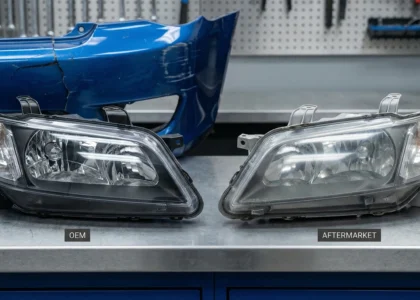
Headlight technology has advanced faster in the last five years than in the previous twenty. Modern vehicles now use complex LED systems, adaptive lighting modules, radar-integrated housings, and high-precision projectors. Because of this evolution, the gap between OEM headlights and aftermarket headlights has widened dramatically.
Collision centers, insurance carriers, and professional repair shops overwhelmingly prefer OEM units because aftermarket headlights continue to create problems that lead to re-work, safety issues, and claim delays. As LED and adaptive systems become standard on nearly every new vehicle, the risks associated with cheap aftermarket parts are higher than ever.
This guide breaks down the real-world differences, failure rates, market pricing, and why OEM headlights continue to dominate the collision repair industry in 2026.
Table of Contents
What Defines an OEM Headlight in 2026
An OEM headlight is produced by the same manufacturer that built the vehicle’s original components. These companies—Koito, Valeo, Stanley, AL, Hella, and others—engineer headlights to exact specifications:
- Beam pattern accuracy
- Reflector geometry
- Module compatibility
- CANBUS communication
- Lens clarity and UV resistance
- Housing durability and seal integrity
OEM headlights are tested under strict regulatory standards before production, including DOT, SAE, and manufacturer-specific optical requirements.
These standards ensure the headlight meets safety, visibility, and durability expectations.
How Aftermarket Headlights Are Made
Aftermarket manufacturers reverse-engineer OEM units. Because they lack exact molds, LED drivers, proprietary plastics, and optical designs, the product is inherently different. Many aftermarket housings fail to match:
- Mounting point geometry
- Reflector alignment
- Lens refractive properties
- Internal sealing
- Thermal heat dissipation for LEDs
- DRL and turn-signal compatibility
The result is often a headlight that looks similar but functions significantly worse.
Fitment deviations as small as 1–2mm cause misalignment and vibration, especially in LED projector housings.
Beam Pattern Accuracy: The Largest Performance Gap
Independent collision repair studies show:
- OEM headlights deliver beam accuracy within 1–2% of factory spec.
- Aftermarket headlights range 8–25% outside spec, depending on brand.
An inaccurate beam pattern leads to:
- Reduced nighttime visibility
- Excessive glare to oncoming traffic
- Failed state inspections
- Insurance rejections
- Adaptive lighting malfunction
With more vehicles using adaptive LED systems, optical accuracy is no longer optional—it is a safety requirement.
Failure Rates: OEM vs Aftermarket
Across the collision repair industry, the most common aftermarket failure categories are:
1. Moisture Intrusion and Fogging
Due to cheaper seals and inconsistent housing tolerances.
2. DRL Flickering or Failure
Aftermarket LED drivers rarely match OEM current requirements.
3. AFS (Adaptive Front-lighting System) Errors
Improper wiring and incompatible modules cause system faults.
4. CANBUS Error Codes
Modern vehicles detect voltage irregularities immediately.
5. Poor Fitment and Misaligned Mounting Points
Creates vibration, headlight wobble, and inconsistent aim.
Shops using aftermarket headlights often face:
- Supplemental estimates
- Delayed cycle times
- Customer complaints
- Insurance disputes
- Repeat labor
For these reasons, many national insurers have updated guidelines to prioritize OEM parts on LED, HID, and adaptive systems.
Cost Breakdown: OEM vs Aftermarket vs Rebuilt OEM
Realistic pricing across major brands in 2026:
OEM Dealer Pricing
- Halogen: $250–$600
- LED: $800–$2,500
- High-end luxury LED: $3,000–$4,800
- Adaptive LED systems: $4,800+
Aftermarket Pricing
- Halogen: $90–$250
- LED: $200–$600
- HID/Projector: $150–$700
Rebuilt OEM Pricing (Highest Value Segment)
- Usually 30–70% cheaper than dealer OEM
- Maintains OEM optics, modules, and fitment
- Insurance approved
- Significantly more reliable than aftermarket
This is precisely why rebuilt OEM headlights have become the fastest-growing part category in the collision repair market.
Why Collision Shops Prefer OEM Headlights
Professional repair facilities overwhelmingly choose OEM because it reduces:
- Installation issues
- Fitment corrections
- Beam alignment failures
- Electrical faults
- Moisture intrusion returns
- Insurance disputes
- Overall cycle time
For customers, an OEM headlight preserves:
- Beam pattern accuracy
- Vehicle value
- Safety
- Cosmetic consistency
- Long-term durability
For shops, it minimizes rework and protects CSI scores.
How Rebuilt OEM Headlights Fill the Market Gap
Rebuilt OEM headlights combine the strengths of OEM with the cost-efficiency shops need.
A high-quality rebuilt OEM headlight goes through:
- Housing inspection
- Module testing (DRL, turn signal, AFS, LED driver)
- Lens restoration or replacement
- Seal inspection and resealing
- Beam pattern verification
- Cosmetic refinishing
The result: OEM-quality performance at a significantly reduced cost, with full insurance approval.
This is the service category where BZN Auto Lights provides direct value to the industry.
Aftermarket Headlights: When Are They Acceptable?
There are only a few scenarios where aftermarket headlights are reasonable:
- Older vehicles (10+ years)
- Non-insurance repairs
- Cosmetic-only replacements
- Extremely budget-constrained customers
- When OEM is discontinued or unavailable
Even in these cases, shops must warn customers about:
- Shorter lifespan
- Higher moisture risk
- Electrical incompatibility
- Optical inconsistency
For modern vehicles, especially 2018–2026 models, aftermarket failure rates make them an unreliable choice.
Questions and Answers
Are OEM headlights really better than aftermarket?
Yes. OEM headlights outperform aftermarket in beam accuracy, durability, fitment, and electrical compatibility.
Why do aftermarket headlights fog up?
Cheaper seals and inconsistent housing tolerances lead to moisture intrusion.
Can aftermarket headlights pass inspection?
Not reliably. Beam pattern and brightness inconsistencies often cause failures.
Are rebuilt OEM headlights good quality?
A properly rebuilt OEM headlight performs the same as new OEM at a fraction of the cost.
Can damaged OEM headlights be sold?
Yes. Shops can sell cracked, fogged, broken-tab, or damaged OEM headlights for core value.
OEM Dominates the Market for a Reason
As LED and adaptive lighting systems continue to advance, the differences between OEM and aftermarket headlights are no longer small—they are structural, optical, and operational.
OEM headlights offer:
- Accurate optics
- Reliable electrical systems
- Proper sealing
- Insurance compliance
- Long-term durability
Rebuilt OEM headlights offer the best overall value, combining OEM performance with significantly lower pricing, faster availability, and full compatibility for insurance repairs.
For collision centers, recyclers, and dealerships, choosing OEM-based solutions is the most cost-effective and reliable approach in 2026.