Headlight damage is one of the most common front-end repair issues in the collision industry. What used to be a simple lens buff job has become a far more technical decision with the rise of LED projectors, adaptive lighting systems, DRLs, radar-integrated housings, and complex headlight electronics.
As a result, the question “restore or replace?” no longer has a simple answer.
In 2026, insurance carriers, repair shops, and drivers need to understand when headlight restoration is appropriate, when it’s unsafe, and when an OEM replacement is the only acceptable option.
This guide provides a full breakdown of costs, safety considerations, legal requirements, insurance guidelines, and the economics of modern headlight repair.
Table of Contents
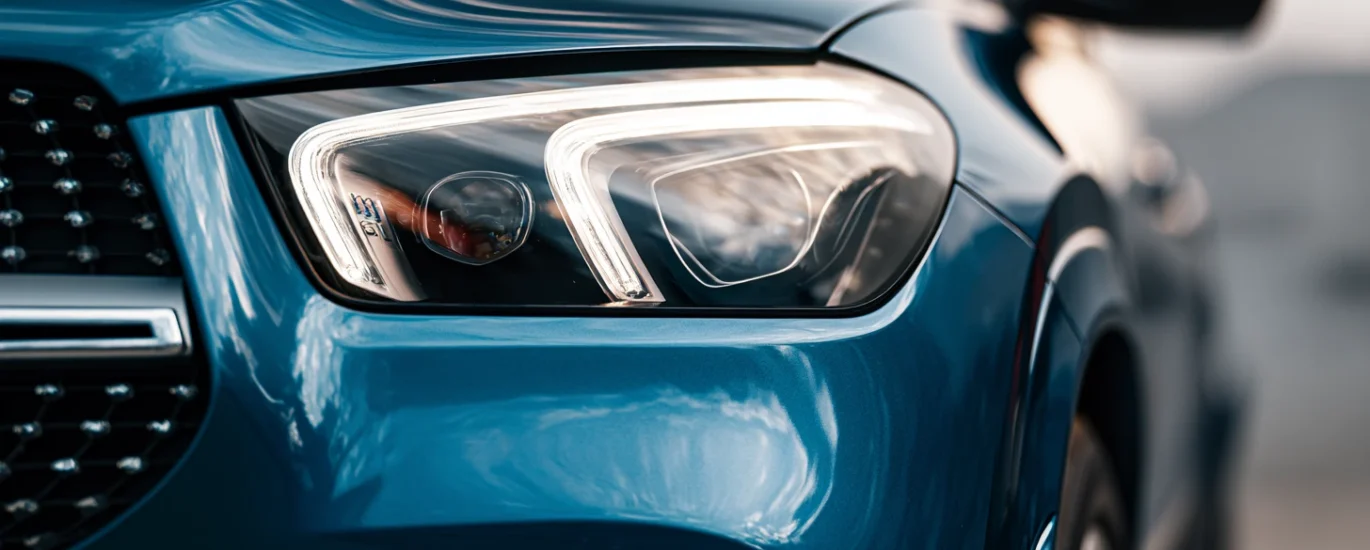
How Headlights Have Changed in the Last Decade
Older vehicles used halogen reflectors with simple plastics. Restoration was usually enough.
Modern headlights now include:
- LED projectors
- Lens optics tied to safety systems
- Adaptive front lighting (AFS)
- DRL light guides
- CANBUS-controlled drivers
- Radar sensors in premium housings
- Cooling systems for high-output LEDs
These systems fundamentally changed what “restoration” means.
Fogging or discoloration is no longer just cosmetic—clarity impacts beam pattern and safety because LED optics rely on precise lens geometry.
What Headlight Restoration Actually Fixes
Professional restoration can improve:
- Surface oxidation
- UV damage
- Light lens hazing
- Minor surface scratches
- Clarity and brightness loss
Restoration is effective only when the damage is limited to the lens surface.
Cost range: $80–$250 per headlight depending on the service.
When Restoration Fails (Most Common in 2018–2026 Vehicles)
Restoration does NOT fix:
- Cracked lenses
- Broken tabs
- Damaged housings
- Water intrusion
- Internal condensation
- Burned LED segments
- DRL failures
- AFS malfunction
- Delaminated UV coatings
- Internal reflector damage
These issues cannot be restored because they affect the structural or optical function of the headlight.
In these cases, replacement is the only safe option, and insurance carriers typically require OEM.
Cost Comparison: Restoration vs Replacement in 2026
Restoration Cost
- Per headlight: $80–$250
- Best suited for older halogen headlights
- No fix for mechanical or electronic problems
Aftermarket Replacement Cost
- Halogen: $90–$250
- LED: $200–$600
- HID: $150–$700
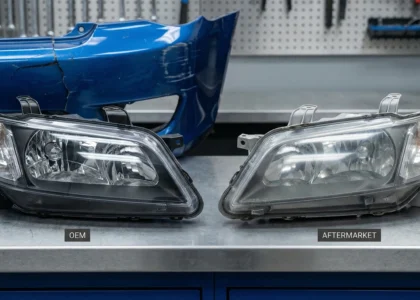
Problems: fitment, fogging, electrical compatibility, insurance rejection.
OEM Replacement Cost (Dealer New)
- Halogen: $250–$600
- LED: $800–$2,500
- High-end adaptive LED: $3,000–$4,800+
Best quality, highest cost.
Rebuilt OEM Replacement Cost
- Typically 30%–70% less than new OEM
- Insurance approved
- Maintains OEM optics, fitment, electrical compatibility
- High availability for collision repair
Insurance Guidelines: When OEM Is Required
Insurance companies deny aftermarket headlights in these cases:
- Vehicles less than 5 years old
- LED or adaptive LED systems
- Projector headlights with calibrated optics
- Radar or camera-integrated housings
- AFS or matrix lighting systems
- High-end brands (BMW, Mercedes, Tesla, Lexus, Audi)
- Aftermarket unit fails photometric testing
- Aftermarket doesn’t match OEM beam pattern
Insurance carriers increasingly refuse restoration for safety-critical optics because the outcome is inconsistent and not guaranteed to meet OEM standards.
Legal Requirements: Restoration vs Replacement
Many states enforce headlight standards for:
- Beam pattern
- Projection distance
- Height and aim
- Brightness
If a restored headlight cannot meet inspection standards, replacement is mandatory.
Common restoration failures include:
- Lens distortion
- Hotspot misalignment
- Cloudiness returning within months
- Beam cutoff deterioration
- Poor aftermarket coatings causing yellowing
Safety Considerations Often Ignored
1. Beam Pattern Degradation
Restoring a lens does not fix internal reflector aging or optical distortion.
2. Module and DRL Failures
LED drivers are sensitive. If the module is damaged, no amount of restoration helps.
3. Housing Seal Failure
Fogging returns quickly if sealing is compromised.
4. Structural Damage
Even a small tab break can misalign the entire beam pattern.
5. Mixed Headlights (OEM + Aftermarket)
This creates mismatched color temperatures and inconsistent performance.
When Replacement Is the Only Correct Decision
Replacement is required when:
- The lens is cracked
- The housing is split or warped
- Moisture persists
- LED segments flicker or fail
- AFS calibration errors appear
- DRL light guides are damaged
- Mounting tabs are broken
- Headlight fails inspection
- The vehicle requires OEM for the claim
In these scenarios, replacing with OEM or rebuilt OEM is the only safe, legal, and insurer-approved option.
Why Rebuilt OEM Headlights Are Becoming the Preferred Solution
Rebuilt OEM headlights have become the middle ground between expensive dealership units and unreliable aftermarket copies.
They offer:
- OEM optical performance
- Correct module compatibility
- Factory-accurate beam pattern
- Structural integrity
- Insurance approval
- Significant cost savings
Collision centers benefit from:
- Reduced cycle times
- Fewer supplements
- Fewer returns
- Lower part expenses
- Improved customer satisfaction
For this reason, rebuilt OEM headlights account for a growing share of the collision parts market in 2026.
Frequently Asked Questions
Is it worth restoring modern LED headlights?
Only when damage is limited to light surface oxidation. Internal LED issues cannot be restored.
Why do restored headlights fog again?
Because the underlying seal or housing is compromised.
Can aftermarket headlights pass inspection?
Often not, especially with LED projectors.
Does insurance pay for OEM headlights?
Most carriers approve OEM for LED or safety-critical optics.
Is replacing cheaper than restoring?
In modern vehicles, yes. Restoration rarely fixes the root cause.
Conclusion
Headlight restoration is still useful for older vehicles with basic halogen housings.
For modern LED, projector, adaptive, and radar-integrated headlights, restoration is often insufficient and unsafe.
In 2026, the repair decision is simple:
- Restore only when the lens surface is the issue.
- Replace when structural, optical, or electronic failure exists.
- Use OEM or rebuilt OEM when beam accuracy, module compatibility, and insurance requirements matter.
Collision centers, recyclers, and repair shops that understand this distinction reduce cycle times, avoid inspection failures, and deliver safer repairs.