A minor crash can leave you with what looks like a simple headlight problem: a cracked lens, a broken tab, a housing that shifted out of place, or moisture starting to build inside the assembly. That is usually when the real question comes up: should you replace it with an OEM headlight or save money with an aftermarket one?
The answer is not just about price. It is about fitment, lighting performance, compatibility with your factory bulbs or modules, and whether the replacement will actually work without extra coding, programming, or rework.
In many cases, aftermarket headlights can physically bolt on and plug in. That does not automatically mean they will fit like the original, produce the same beam pattern, or work correctly with the vehicle’s lighting system. For some cars, especially newer ones, that distinction matters a lot.
What is the real difference between OEM and aftermarket headlights?
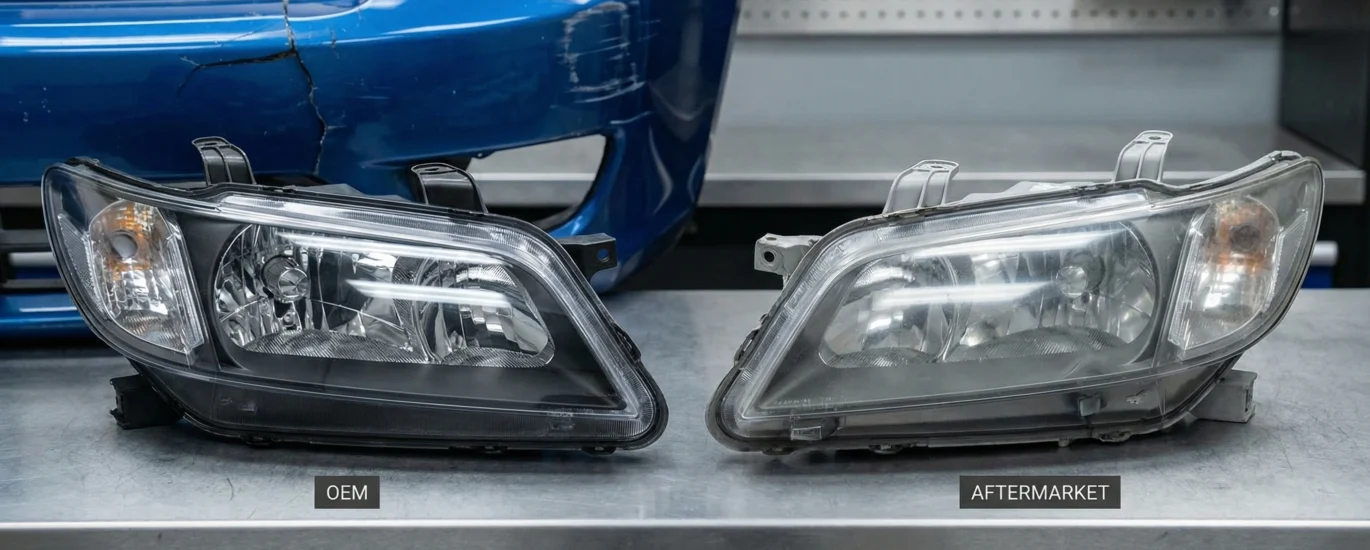
OEM headlights are built to match the original specifications of the vehicle. That includes the shape of the housing, mounting points, connector design, lens quality, internal reflectors, and how the light is distributed on the road.
Aftermarket headlights are made by third-party manufacturers. Some are decent. Some are not. The biggest issue is inconsistency. Two headlights may look nearly identical online, but the real-world differences can show up during installation or after the vehicle is back on the road.
The most common differences between OEM and aftermarket headlights are:
- fitment at the fender, bumper, grille, and mounting points
- lens clarity and long-term durability
- beam pattern and light output
- seal quality and resistance to condensation
- compatibility with bulbs, ballasts, drivers, or modules
- consistency from one unit to the next
That is why “it fits” is not the same as “it works like factory.”
After a minor crash, the damage is often more than the lens
A cracked headlight housing is rarely just cosmetic. Even in a low-speed impact, the assembly can suffer damage that is easy to miss during a quick inspection.
Common issues after a minor crash include:
- broken or stressed mounting tabs
- hairline cracks in the housing
- moisture intrusion
- damaged adjusters
- bent brackets behind the light
- internal reflector or projector damage
- wiring or module damage on more advanced systems
A headlight can still turn on and still be a bad assembly. If the housing is compromised, water and condensation can get inside, hardware can loosen over time, and the beam pattern can shift. That is one reason replacement is often the better option than trying to patch a damaged housing.
Will an aftermarket headlight reuse factory bulbs?
Sometimes, yes. Sometimes, no. And even when the answer is yes, there is usually more to it.
Whether factory bulbs can be reused depends on the lighting system and the design of the replacement assembly. A basic halogen setup is usually the least complicated. In those cases, the factory bulbs may transfer over without much trouble.
Things get more complicated when the vehicle uses:
- HID/Xenon components
- LED modules or drivers
- adaptive front lighting
- auto-leveling systems
- separate ballast or control modules
- integrated daytime running light electronics
Some aftermarket assemblies accept factory bulbs but not factory modules. Some require you to swap over original components from the damaged unit. Some physically accept the parts but still do not perform the same way once installed.
This is the key point: reusing factory bulbs does not guarantee factory performance.
A bulb may fit in the socket, but that does not mean the housing geometry, reflector design, cutoff, or output will match the original OEM assembly.
Are aftermarket headlights really plug and play?
This is where a lot of buyers get burned.
“Plug and play” is one of the most overused phrases in headlight listings. Sometimes it simply means the connector matches. That is not the same thing as saying the part will install cleanly, line up correctly, and work exactly like the original.
A headlight can be “plug and play” on paper and still create problems such as:
- uneven gaps with the bumper or fender
- weak or misaligned mounting tabs
- warning lights on the dash
- condensation from poor seals
- poor beam pattern
- flickering or inconsistent operation
- incompatibility with transferred modules
On older vehicles with simple halogen systems, plug-and-play replacement is more realistic. On newer vehicles with LED or adaptive headlights, the phrase should be treated carefully.
Do replacement headlights need programming?
Sometimes. Not always.
This depends on what type of headlight system the vehicle has and what is built into the assembly.
Cases where programming may not be required
Vehicles with basic halogen headlights often do not require programming when replacing the full assembly, assuming the replacement is correct and no separate control electronics are involved.
Cases where programming, coding, or calibration may be required
Programming or related setup may be needed when the assembly includes or interacts with:
- LED control modules
- HID ballasts
- adaptive lighting functions
- matrix lighting systems
- cornering lights
- auto-leveling features
- vehicle communication modules tied into the light
In some repairs, the replacement headlight itself is not what gets programmed, but the transferred module, lighting control unit, or vehicle system may still need setup, calibration, or coding to function properly.
So the accurate answer is this: some headlight replacements are straightforward, but many newer systems are not truly install-and-go.
OEM vs aftermarket: which makes more sense after a minor crash?
There is no honest one-size-fits-all answer. The better choice depends on the vehicle, the lighting system, the budget, and how important factory-level fit and performance are to the owner.
When OEM usually makes more sense
OEM is usually the safer choice when:
- the vehicle is newer
- the vehicle has LED, HID, or adaptive headlights
- exact fitment matters
- the owner wants factory beam pattern and finish
- the repair needs to look right the first time
- resale value and appearance matter
- the buyer wants to reduce the chance of electrical surprises
OEM usually costs more up front, but it often reduces the risk of rework, compatibility issues, and disappointing light performance.
When aftermarket may be acceptable
Aftermarket can make sense when:
- the vehicle is older
- the lighting system is basic
- the owner is working with a tighter budget
- a slight difference in finish or fit is acceptable
- the part is from a reputable source and carefully verified
That does not mean all aftermarket headlights are bad. It means buyers should stop assuming they are equivalent.
The beam pattern problem most people do not think about
A headlight is not just a housing with a bulb inside. Its job is to aim and distribute light correctly. That is what makes beam pattern such a critical issue.
Even if an aftermarket assembly looks close to OEM, the real performance difference may show up at night:
- weaker road illumination
- glare to other drivers
- inconsistent cutoff
- scattered light
- poorer visibility in rain or dark roads
For drivers who spend time on the highway or in rural areas, this is not a small detail. It affects real-world visibility and safety.
That is part of why OEM assemblies remain the preferred option for many repairs, especially when maintaining factory performance matters more than finding the lowest possible replacement cost.
What to verify before buying any replacement headlight
Before ordering an OEM or aftermarket replacement, verify more than just the year, make, and model.
Check:
- trim level
- left or right side
- halogen, HID, or LED type
- whether the vehicle has adaptive or auto-leveling features
- whether modules, ballasts, or drivers are included
- whether factory bulbs transfer over
- whether programming or calibration may be required
- whether the mounting tabs and connectors match exactly
This is where many wrong-part problems start. A listing may look correct until you find out the assembly is for a different trim, a different lighting package, or a vehicle with different electronics.
Final answer
If your headlight housing cracked after a minor crash and you want the best chance of correct fit, correct function, and long-term reliability, OEM is usually the safer option.
Aftermarket headlights can work in some situations, especially on older vehicles with simpler systems. But they should not be treated as automatically identical to the original. A connector match is not enough. The real questions are whether the assembly fits correctly, reuses the right components, produces a proper beam pattern, and works without extra programming or calibration.
That is why the smart approach is not just asking, “Will it bolt on?” It is asking, “Will it actually perform like the factory headlight once the job is done?”
If the goal is fewer surprises, fewer fitment issues, and better odds of a proper repair, OEM usually wins.
FAQ
Is OEM better than aftermarket for headlights?
Usually, yes. OEM headlights are generally the safer choice for fitment, compatibility, and factory-like light performance. Aftermarket can work, but quality varies.
Can I reuse my factory bulbs in a replacement headlight?
Sometimes. It depends on the vehicle and the type of headlight system. Basic halogen setups are usually simpler than HID, LED, or adaptive systems.
Do all replacement headlights need programming?
No. Many basic halogen assemblies do not. But newer headlights with modules, LED systems, HID components, or adaptive functions may require programming, coding, calibration, or module transfer.
Is a cracked headlight housing a big deal after a minor crash?
Yes. Even if the damage looks small, cracks can let in moisture, weaken the assembly, and affect long-term performance.
Are aftermarket headlights truly plug and play?
Sometimes, but not always. A matching connector does not guarantee proper fit, proper beam pattern, or full compatibility with the vehicle’s lighting system.